The Intercollegiate
Trading Championship
The Rival Cup is a national trading championship for college clubs. Two open weeks. A national bracket. Your squad trades and every score counts. $10,000 in prizes, champion crowned before Thanksgiving.
Free to enter. No entry fee, ever. Any officially recognized student club, any number of clubs per school. Open to enrolled students 16 and over with a .edu address.
Everybody Trades.
One Club Wins.
Two students are enough to enter a national championship. Name your squad, and every member who trades counts toward the team score. The open round decides who makes the bracket. After that it's single elimination, one week at a time.
Registration
A captain creates the team and shares one join link. Members tap it, sign up with their .edu address, and they're on the roster. Add freely through October 9 — after that, five adds and five drops for the rest of the Cup.
The Open Round
Two separate scoring weeks, every registered team, every member starting fresh at $1,000,000 each week. Your two weekly scores are averaged. That average decides both who advances and how they're seeded — and you need a score in both weeks to make the bracket.
Seeding Reveal
We cut the field, set the bracket, and publish every matchup through to the final.
The Bracket
One week per round, head to head. Portfolios reset to a fresh $1,000,000 every round, so every matchup is a clean fight. Both clubs field their squad. Higher team score advances. Lose and you're out of the bracket — but your club keeps trading every week, still chasing the individual award and the rankings.
The Final
One week, two clubs, one more fresh start. Same rule that got you here: highest team score takes the Cup. Champion crowned November 20, before Thanksgiving.
$10,000 on the
Line.
The college trading championship pays out $10,000 — $9,500 across the top four clubs, plus a $500 award for the single best individual round of the tournament. Prize money goes to the club, not to individual traders. It's a real budget line for the organization that earned it. The champion takes the trophy and the Cup.

Paid to the clubs, not to individual traders. For most college clubs that is a bigger budget than a full year of dues.
How the prize is paid
Prizes are awarded to the winning club as an organization. Before payment, each winning club designates a recipient: a university-administered student organization account, the college or university itself, a university foundation, a registered nonprofit associated with the club, or another school-affiliated recipient we approve. Wall Street Rivals does not pay prize funds to individual students, and may verify a designated recipient before funds are released. Where a club cannot designate an acceptable recipient within a reasonable deadline, the prize passes to the next eligible club.
Returns Alone Don't
Win a Championship.
A single strong week proves little. We score the college trading championship on a risk-adjusted basis: returns measured against the risk taken to get them, with math that doesn't break. A club that grinds out a steady 6 percent beats a club that swung to 8 percent through three brutal drawdowns. That is how an allocator would judge them, and how a recruiter will read them.
Sharpe Ratio
Divides return by all volatility. That punishes a club for having good days, which is the opposite of what a competition should reward.
Sortino Ratio
The Sortino ratio divides by downside only, which is better. But dividing breaks twice: it blows up when a team has no losing days, and it inverts when both teams are negative, so the club that thrashed harder scores better.
The Rival Score
Subtracting never breaks. It ranks 40 teams in the open round and 2 teams in a final the exact same way, with no divide-by-zero and no sign flip. Same formula, start to finish.
Real Market Data.
Real Order Types.
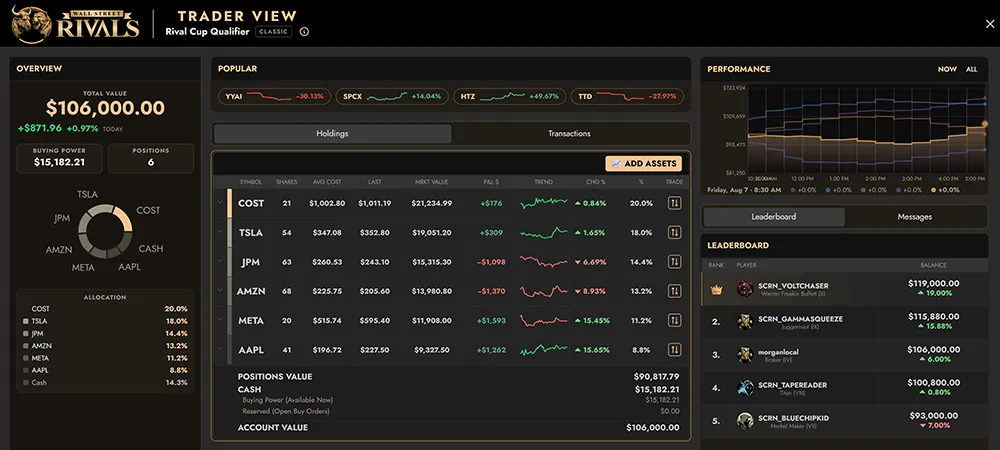
The college trading championship runs on Wall Street Rivals: live prices, long and short, market, limit and stop orders. Your members are trading the same mechanics they'll use on a desk, without a dollar at risk.
Watch your club advance
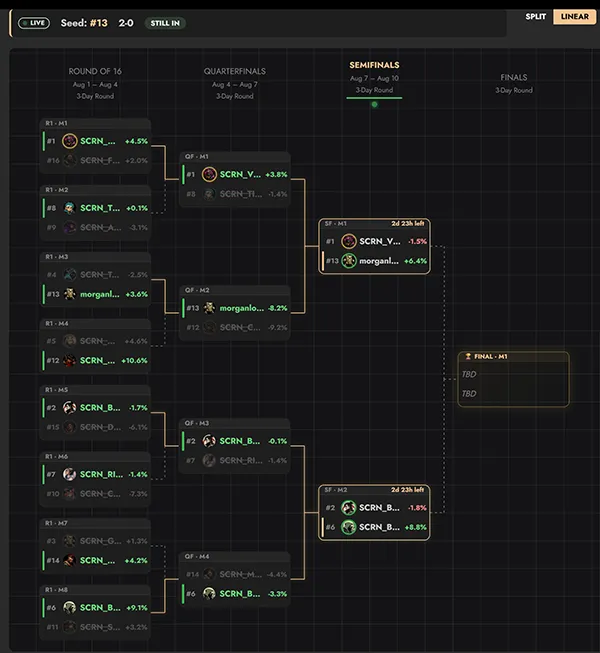
We publish the full bracket the moment the field is cut, every matchup set through to the final. Each card carries both clubs, their seeds and their live score for the round, so members can follow the whole tournament and not just their own portfolio.
Seeds carry through from the open round, and rounds run one at a time. A club that is still alive shows on the bracket the way a tournament team does, which is exactly the point.
Screens show a demonstration contest. Field size, round length and dates follow the schedule above.
Register Your
Club.
Registration is open and closes October 2. Name your club, pick your school, and you'll have a join link to drop in your group chat before you close this tab. Free, and free forever.

Name your club
Club name, school, your .edu address. You'll set a password on the next screen and your team exists a moment later.
Share one link
Your join link is waiting the moment your team exists. Drop it in the group chat and every member who taps it lands on your roster.
Trade the open round
October 5, everyone starts with $1,000,000. Two weeks later you find out if you made the bracket.
Any officially recognized club competes. Two students are enough. Add freely through October 9, then five adds and five drops through the Championship.
College Trading
Championship Rules.
Two students are a team
Two is the minimum to post a team score and twelve is the maximum roster. A two-person club and a twelve-person club are both real entries. Bigger clubs pick their squad however they like, including a qualifier run on the platform.
One trade puts you in the score
Place a single executed trade in a round and your portfolio counts toward your club's average for that round. Trade nothing and you're left out of the average entirely, so you never drag your club down. Once you're in, you're in for the round.
Long and short
US-listed equities and equity ETFs, long or short, regular market hours. No leveraged products above 2x, no money-market instruments.
Concentrate all you want
Put the whole portfolio in one name if you like — there's no concentration limit. Two guardrails only: total long-plus-short exposure caps at 200% of your equity, and single-day orders in one security are capped at 1% of its recent average volume so nobody trades size the market couldn't absorb.
Cash earns nothing
A dollar in cash is a dollar all week. Going flat is a legitimate strategy — it just scores zero, which is a real decision in a down week and a losing one in an up week.
Fresh start every round
Every member gets a new $1,000,000 at the top of each round, final included. No round carries over. Every matchup is a clean fight from the same starting line.
Read the full official rules →
As many clubs from one school as want to enter. The Cup is won by a club, not by a campus.
For Faculty.
No Work Required.
Investment club participation peaks at September sign-ups and thins by midterms. The Rival Cup gives members a reason to show up every week through the end of the semester, and asks nothing of you to make it happen.
You do not have to be involved
A student officer registers the club and runs the roster. A faculty advisor is welcome at any point and never necessary. Clubs with no advisor compete on exactly the same footing.
Nothing crosses your desk
Scoring, standings, matchups and payouts are handled by the platform. There are no dues to collect, no funds to hold, and no money passing through the department. Getting started requires only a club name.
Prizes go to the organization
Prize money is paid to the club as an organization, never to students individually. Before payment the club designates a recipient: a university-administered student organization account, the institution, a university foundation, or a registered nonprofit associated with the club. For most clubs, a placement is a bigger budget than a full year of dues.
Follow along if you want to
Email hello@wallstreetrivals.com with your club's name and we will send you their standing after every round. No account, no login, and you can stop it any time.

The Best Club
in the Country
Has Yet to Be Named.
Registration is open now and closes October 2. The first champion is crowned before Thanksgiving.
Register Your Club →